Roman cuisineCacio e pepe · Gricia · Amatriciana · CarbonaraCulture & historyUpdated 11 min read
Roman Pasta Dishes: The Complete Guide to Rome's Four Iconic Pastas (and More)
Rome's pasta tradition is built on four related dishes — cacio e pepe, gricia, amatriciana and carbonara — that share the same short list of ingredients rearranged into four distinct classics. Master how they relate, and you understand Roman cooking itself.
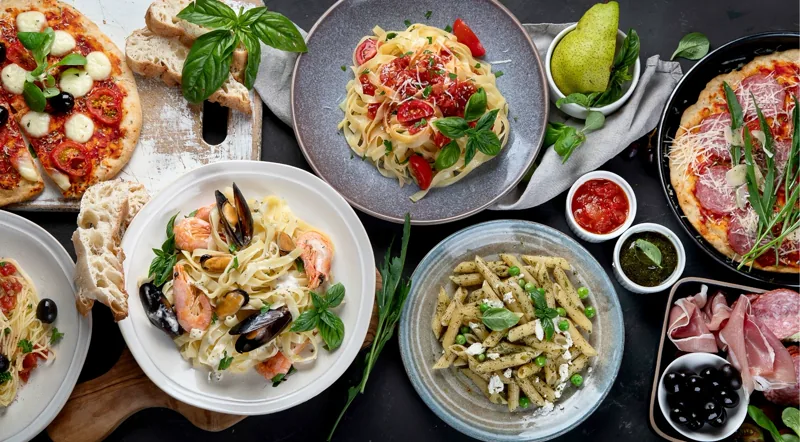
Cacio e pepe, gricia, amatriciana and carbonara — four dishes, one shared family of ingredients.
RC
Rome Cooking Class — editorial team
Compiled from Roman culinary history sources and GetYourGuide partner class data, July 2026.
The Roman Pasta "Family Tree"
The single most useful thing to understand about Roman pasta is that the four classics are variations on a theme:
Cacio e pepe = pecorino romano + black pepper + starchy pasta water
Gricia = cacio e pepe + guanciale
Amatriciana = gricia + tomato
Carbonara = gricia + egg (yolk)
Learn carbonara & cacio e pepe · from €70
Check live availability and prices for this tour on GetYourGuide. Pоwered by GetYourGuide.
Two ingredients hold the whole system together: pecorino romano, the sharp, salty sheep's-milk cheese, and guanciale, cured pork jowl whose slow-rendering fat is the technical backbone of three of the four dishes. Understanding these two ingredients, and why substitutes fail, is the key to the entire cuisine.
Learn it hands-on
Reading about the family tree is one thing — internalising the emulsification method that all four dishes depend on is another. A pasta making class in Rome is the fastest way to learn it by doing.
Cacio e Pepe: The Deceptively Simple Foundation
What it is: Cacio e pepe means "cheese and pepper." It's just three things — pecorino romano, freshly cracked black pepper, and the starchy water the pasta cooked in — tossed together into a glossy, creamy sauce. No cream, no butter, no oil.
Why it's hard: The whole dish rests on emulsification. You have to melt finely grated pecorino with starchy water into a smooth cremina that coats the pasta. Get the temperature wrong and the cheese proteins seize into rubbery lumps instead of a sauce — a 2025 peer-reviewed physics study (which went on to win an Ig Nobel Prize) found that once the sauce rises above roughly 65°C the cheese proteins denature and clump, and recommends pre-dissolving starch at around 2–3% of the cheese mass to stabilise the sauce reliably.
The traditional shape: In Rome, cacio e pepe is classically served with tonnarelli — a fresh, square-cut egg pasta also known as spaghetti alla chitarra — though spaghetti and bucatini are also common. Tonnarelli's rough, porous surface grips the sauce.
On the history: The romantic story credits shepherds who carried dried pasta, aged pecorino and pepper on long transhumance journeys. Food historians are skeptical — pepper was historically expensive, and the dish is more likely a relatively recent codification than an ancient one. One of the earliest printed versions appears in Ada Boni's La Cucina Romana (1930).
Learn cacio e pepe hands-on
Trastevere Pasta Masterclass with Foodies from Rome
★★★★★Rated 5.0 out of 55.0·73 reviews·€70·3 hoursFree cancel · 24h
Learn from local experts how to prepare three iconic pasta dishes and sauces — including cacio e pepe spaghetti — then delight in your creations with a glass of wine. A small-group workshop in Trastevere.
Cacio e pepe spaghetti made from scratch
Tortelloni and ravioli in the same session
Wine or lemon soft drink
Digital recipe PDFs to take home
Check live prices and today's availability for this class.
Opens on GetYourGuide · free cancellation up to 24 hours before
Gricia: The "White Amatriciana" and the Ancestor
What it is: Pasta alla gricia is cacio e pepe plus guanciale — pasta with rendered guanciale, pecorino romano and black pepper, but no tomato and no egg. It's often called the amatriciana bianca ("white amatriciana") and is widely considered the ancestor from which amatriciana and, arguably, carbonara descend.
The technique: Render the guanciale slowly so its fat melts out, then build a creamy emulsion of that fat, grated pecorino and starchy pasta water off the heat — the same temperature discipline as cacio e pepe, with the added richness of pork fat.
Traditional shape: Rigatoni and mezze maniche (their ridges catch the sauce) are the most traditional, though spaghetti, bucatini and tonnarelli all appear.
On the name: This is genuinely contested. One theory derives gricia from Grisciano, a hamlet near Amatrice; another traces it to gricio, the Romanesco word for sellers of ordinary foodstuffs in papal Rome. Both are plausible and neither is settled.
Other experiences you might enjoy
Worth adding to your itinerary
Once you know your gricia from your amatriciana, round out your trip with a Testaccio market food tour, a Trastevere food and wine walking tour, a Jewish Ghetto food tour, or a day trip to Amatrice's home region in Lazio. Here's a live feed of other top-rated Rome tours and experiences worth adding to your trip.
This site contains affiliate links. We may earn a commission when you book through our links at no extra cost to you.
Amatriciana: Gricia Meets the Tomato
What it is: Add tomato to gricia and you get amatriciana — guanciale, tomato, pecorino romano, black pepper, usually a splash of dry white wine and a little chili.
Where it's from: Not Rome, originally. Amatriciana takes its name from Amatrice, a mountain town in the province of Rieti. The dish travelled to Rome with shepherds and migrants and became a pillar of Roman cuisine by adoption.
The rules are strict
Amatrice's municipality has publicly stated that "the only ingredients in a true amatriciana sauce are guanciale, pecorino, white wine, San Marzano tomatoes, black pepper and chili pepper." No garlic, no onion. Guanciale is non-negotiable — pancetta and bacon are substitutes, not the real thing.
Legal recognition: "Amatriciana Tradizionale" was registered as an EU Traditional Speciality Guaranteed (TSG) in 2020 — the same scheme that protects Pizza Napoletana. After the devastating 2016 Amatrice earthquake, restaurants across Italy and the world put amatriciana on their menus and donated proceeds to reconstruction — the dish had always carried the town's name, and after 2016 it carried its story too.
Traditional shape: Amatrice officially specifies spaghetti. In Rome, though, bucatini became the signature choice, with rigatoni and mezze maniche also common.
Amatriciana, cacio e pepe and carbonara often share a table on the same Roman menu.
Carbonara: The Youngest — and Most Fiercely Defended
What it is: Carbonara is gricia plus egg — guanciale, pecorino romano, egg (yolk-forward) and lots of black pepper, emulsified with the heat of the pasta into a silky sauce. There is never cream in authentic carbonara — the creaminess comes entirely from egg and cheese.
The origin, presented honestly: Carbonara is almost certainly a post-WWII dish. It appears in no cookbook before the war, and the most widely accepted account is that it emerged from the encounter between Italian cooking and American military supplies after the Allied liberation of Rome in 1944.
1950 — the first known mention of "spaghetti alla carbonara" appears in an Italian newspaper.
1952 — the first written recipe appears, not in Italy, but in a Chicago restaurant guide — using tagliarini, Italian bacon, eggs and grated parmesan.
1954 — the first Italian recipe runs in La Cucina Italiana magazine, calling for pancetta, garlic and Gruyère.
1960 — guanciale first replaces pancetta in a printed recipe — which also adds cream.
1990s — cream is finally dropped and the strict guanciale/pecorino/egg/pepper "canon" solidifies.
Older romantic theories — that it was named for the carbonari (charcoal burners) of the Apennines — are widely dismissed by historians as charming but unsupported. Every 6 April, #CarbonaraDay celebrates the dish as one of the world's largest social-media food events.
Traditional shape: Spaghetti is canonical, but rigatoni, mezze maniche and bucatini are all common in Rome.
Learn carbonara hands-on
Fresh Pasta-Making Class with Italian Chef and Wine
★★★★★Rated 5.0 out of 55.0·80 reviews·€85·3 hoursFree cancel · 24h
Join Chef Riccardo and his team for an authentic cooking class — discover methods for cooking Roman specialities like carbonara and cacio e pepe from scratch, in a small group, with a 3-course meal and wine tasting included.
Roman specialities: carbonara and cacio e pepe
Long pastas and stuffed pastas from scratch
Selected organic wine
3-course meal included
Check live prices and today's availability for this class.
Opens on GetYourGuide · free cancellation up to 24 hours before
The Ingredient Rules: Why They're Not Snobbery
Guanciale vs. pancetta vs. bacon. Guanciale is cured pork cheek/jowl, a single firm muscle with a thick vein of fat, cured with salt and pepper for months and never smoked. Pancetta is cured pork belly — leaner, milder and unsmoked. Bacon is also pork belly but typically smoked. The difference is technical, not tribal: guanciale's fat renders slowly and completely, leaving behind a flavourful cooking fat that carries the cured-meat aroma into the sauce; pancetta's leaner fat melts too fast, and bacon's smoke overwrites the dish.
Pecorino romano vs. parmesan. Pecorino romano is a hard, sharp, salty sheep's-milk cheese with DOP status. Parmigiano Reggiano is a milder, nuttier cow's-milk cheese. In Roman pasta, pecorino's salt and sharpness are structural — they season, add body and cut the richness of egg and pork. Swapping in parmesan changes both the flavour and the way the sauce behaves.
The Pasta Shapes of Rome
Tonnarelli — fresh square-cut egg pasta, cut on a wire "guitar" frame; the classic vehicle for cacio e pepe.
Bucatini — thick, hollow spaghetti; the Roman signature for amatriciana.
Rigatoni — large ridged tubes; classic for gricia and carbonara.
Mezze maniche — short ridged tubes; traditional for gricia and amatriciana.
Spaghetti — the everyday long pasta and Amatrice's official choice for amatriciana; canonical for carbonara.
Want to actually make these shapes yourself? Our pasta making class in Rome guide breaks down how tonnarelli, fettuccine and ravioli are rolled and cut by hand.
Beyond the Big Four: More Roman & Lazio Pastas
Pasta alla papalina — "the Pope's pasta," a carbonara-adjacent dish swapping guanciale for prosciutto and pecorino for parmigiano, often with peas and cream, usually made with fettuccine.
Rigatoni con la pajata — a bold cucina povera classic from Testaccio, made with the intestine of an unweaned calf, stewed with tomato — a true taste of Rome's "quinto quarto" offal tradition.
Penne all'arrabbiata — tomato, garlic, olive oil, chili and parsley on penne; simple, fast, vegetarian-friendly and a fixture of Roman trattorias.
Spaghetti alla checca — a summer dish of pasta with a no-cook sauce of ripe tomatoes, basil, olive oil and often mozzarella or burrata.
Fettuccine Alfredo — genuinely Roman in origin (created by restaurateur Alfredo Di Lelio in the early 1900s as fettuccine, butter and parmigiano, no cream), but now largely an American phenomenon; in Italy today it's rarely called "Alfredo" and mostly appears on tourist menus.
Pasta e ceci and pasta e fagioli — humble cucina povera soups-cum-pastas, distinguished in the Roman version by a few anchovies and rosemary.
Where to Eat & How to Learn
Rome's best pasta is generally found in traditional trattorie and osterie rather than tourist-facing restaurants near the major monuments. The neighbourhoods most associated with authentic Roman cooking are Testaccio (often called the birthplace of Roman cuisine), Trastevere (classic trattorias, though increasingly touristed), and the Jewish Ghetto (for Roman-Jewish specialities). Look for short menus in Italian, daily specials on a chalkboard, and rooms full of locals.
If you'd rather make these dishes than just order them, weaving a class into your trip is the move. Explore cooking classes in Rome, or go deep on technique in a pasta making class in Rome — watching a chef control heat and emulsion in person is worth more than a dozen written recipes.
Turn tasting into skill
Top Pasta Making &Wine Dessert Limoncello by Pantheon
★★★★★Rated 4.9 out of 54.9·3,357 reviews·€59·3 hoursFree cancel · 24h
Rome's most-reviewed pure-pasta class — 3,357 reviews at 4.9 — teaching three fresh pasta shapes with a team of instructors inside Palazzo Grazioli, two minutes from the Pantheon, finished with organic Tuscan wine, limoncello and dessert.
Three fresh pasta shapes with a team of instructors
Sit-down meal of your own pasta
Organic Tuscan wine
Limoncello and dessert to finish
Check live prices and today's availability for this class.
Cacio e pepe (pecorino romano and black pepper), gricia (add guanciale), amatriciana (add tomato), and carbonara (add egg). They share a common ingredient base and are best understood as variations on one theme.
What's the difference between carbonara and gricia?
Gricia is guanciale, pecorino romano and black pepper — no egg, no tomato. Carbonara is essentially gricia plus egg (yolk-forward), which creates its signature silky, golden sauce.
Is there cream in real carbonara?
No. Authentic carbonara gets its creaminess from egg and pecorino emulsified by the residual heat of the pasta. Cream did appear in some Italian recipes from the 1960s to the 1980s, but it was dropped by the 1990s and is now considered a mistake by purists.
What's the difference between guanciale and pancetta?
Guanciale is cured, unsmoked pork cheek or jowl with a high, slow-rendering fat content and an intense cured-meat flavour. Pancetta is cured pork belly — leaner, milder and more versatile. Guanciale is the traditional and technically correct choice for the Roman classics; pancetta is an acceptable substitute when guanciale isn't available.
What pasta is used for cacio e pepe?
Traditionally tonnarelli — fresh, square-cut egg pasta, also known as spaghetti alla chitarra — in Rome, though spaghetti and bucatini are also very common.
Is amatriciana from Rome?
No — it originates in Amatrice, a town in the Rieti province of Lazio. It became a Roman staple by adoption when shepherds and migrants brought it to the city. It's now an EU-protected Traditional Speciality Guaranteed (TSG) dish.
Can I learn to cook these dishes in a Rome cooking class?
Yes. Several Rome pasta classes teach one or more of the four dishes hands-on, most commonly cacio e pepe and carbonara — the two where watching a chef control heat and emulsion in person makes the biggest difference. Look for a class description that names the specific sauces taught rather than a generic "Roman sauce."
Book a Rome pasta class and learn these dishes hands-on
Reading about cacio e pepe is one thing — feeling the emulsion come together yourself is another. Every class on this site books through GetYourGuide with free cancellation up to 24 hours before.
Free cancellation up to 24 hours before the class starts
Instant confirmation and a mobile voucher — no printing
Local chefs, English-language classes, from €25 per person