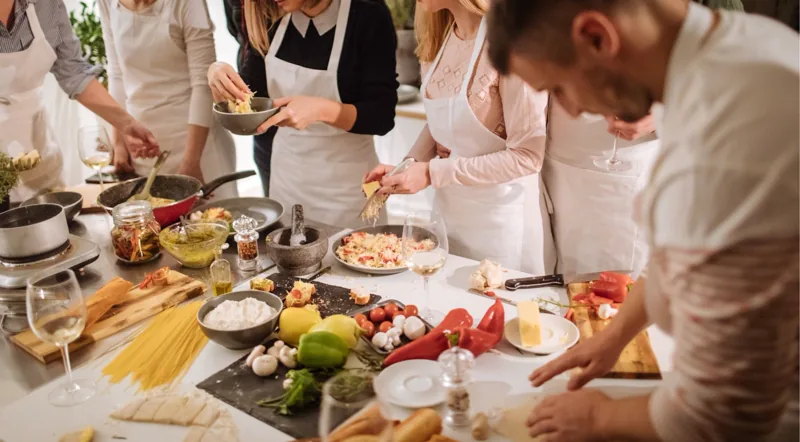
Rome cooking classes run throughout the year, so the time of day usually matters more than the month. A useful strategy is to schedule the class during the part of the day you would least want to spend sightseeing outdoors.
In July and August, an early-afternoon class is particularly useful because it takes you indoors during the hottest part of the day and leaves the cooler evening free. In November and December, an evening class works well because you can use the limited daylight for sightseeing first and have dinner as part of the class.
April, May and October are the easiest months to plan around, with generally comfortable conditions before and after the class. January and February are among the quieter months for sightseeing in Rome, while cooking classes continue to operate throughout winter.
If your travel dates are already fixed, there is little reason to choose or avoid a month specifically for the cooking class. Instead, choose the start time that makes the best use of the weather and daylight on your day.
- When you are visiting
- Best start time
- July and August
- Early afternoon
- April, May and October
- Almost any start time
- November to February
- Evening
- A hot day in the forecast
- Early afternoon
- A cool or rainy day
- Any convenient start time
- Best months for sightseeing around the class
- April, May and October
- Quieter months in Rome
- January and February
- Worth checking for your exact date
- Temperature, rain and sunset
- Start times offered
- 9am to 7:45pm
- Class length
- 2 to 3 hours
- Sunset, mid-December
- 16:40
- Sunset, mid-June
- 20:47
Booking opens a GetYourGuide page in a new tab. We earn a commission if you book; it costs you nothing extra.
Check dates and start times
Pick a date to see which start times are open on it.
Check your own date
Put in the day you want the cooking class. Inside 16 days the card reads the live forecast; beyond that it falls back to the long-term averages for that month, and it says which of the two you are looking at.
Typical conditions for a day in September
Long-term station averages for September.
- Days at 30 °C or above4 days
- Sunset19:20
- Booking pressureAbove an average month Arrivals across the province of Rome run at 112 against an average month of 100. A demand indicator, not a count of people in a kitchen.
Any start time works
Conditions are mild either side of the class, so pick the hour that fits the rest of your day. This is also when a terrace table over Piazza Navona is the better pick.
The card checks the forecast or the long-term average for your date, how many days that month runs at 30 °C or above, when the sun sets, how busy Rome is and whether the date is an Italian public holiday. It does not know which start times are still open — only the calendar above does.
How year-round are Rome cooking classes?
Year-round in the ordinary sense: there is no closed season, and no month is missing from any booking calendar we looked at.
What we checked, on September 11, 2026. We read the booking calendars of six of Rome's most-reviewed cooking classes and counted the dates each one was offering over the following twelve months.
- Every one of the six was bookable on at least 326 of the next 366 days; two were bookable on all 366.
- Four of the five whose individual dates we could resolve were offering places on 15 August, the Ferragosto public holiday.
- Christmas Day and New Year's Day are the two dates where the choice narrows, to two of those five.
This is a snapshot of one day's calendars rather than a published timetable. Operators change their start times, and the availability widget above is the only thing that knows your own date.
Which start time to book
Start times for a Rome cooking class run from about 9am to 7:45pm, and most classes sell three or four of them on the same day. That is a choice you still have after the flights are booked, and it is the one that changes how a cooking class fits your trip.
In July and August a useful strategy is to schedule the class during the part of the day you would least want to spend sightseeing outdoors. Rome averages 23 days at 30 °C or above in August and 21 in July, and the worst of that heat sits in the early afternoon — so a class starting around midday or 1pm takes the least usable part of the day and leaves the cooler evening free. In mid-August the light lasts until 20:11, so there is plenty of evening left to use.
From November to January the scarce thing is daylight instead. Sunset is 16:50 in mid-November and 16:40 in mid-December, so an evening class is the obvious one: it uses hours in which there was nothing left to see outside, and it doubles as dinner. January is a little less tight, with the sun down just after 17:00 by mid-month.
In spring and autumn nothing pushes you either way. April, May and October sit between 18.8 and 23.4 °C in the afternoon, which is comfortable for walking before or after, and these are also the months when the four classes that eat on a terrace over Piazza Navona make more sense than an indoor dining room.
One thing no month changes: the class fills a fixed block. A two-hour class booked at 12:30 is over by about 14:30, and a three-hour class booked at 7:30pm runs past 22:00. Check the duration on the option you pick before you build the rest of the day around it.
Other Rome experiences you might enjoy
If the kitchen is one afternoon of a longer trip, Rome's other food experiences work the same way: gelato workshops, pizza classes near Piazza Navona, Trastevere food tours and wine tastings in Frascati run at set start times through the year. These are the ones bookable right now.
Rome month by month, around your class
A cooking class does not move with the season. Rome does, and since most of a trip happens outside the kitchen, this is the table that decides which start time you want and what you will be doing either side of it.
| Month | Average high | Days at 30 °C or above | Rain | Sunset on the 15th | Visitor demand |
|---|---|---|---|---|---|
| January | 12.0 | 0 | 68 mm over 8 days | 17:04 | 67 |
| February | 13.0 | 0 | 65 mm over 8 days | 17:43 | 77 |
| March | 15.8 | 0 | 62 mm over 7 days | 18:16 | 95 |
| April | 18.8 | 0 | 74 mm over 8 days | 19:51 | 105 |
| May | 23.4 | under 1 | 62 mm over 6 days | 20:23 | 118 |
| June | 28.1 | 9 | not published | 20:47 | 117 |
| July | 31.0 | 21 | not published | 20:44 | 118 |
| August | 31.6 | 23 | not published | 20:11 | 102 |
| September | 26.7 | 4 | 68 mm over 6 days | 19:20 | 112 |
| October | 22.2 | 0 | 92 mm over 8 days | 18:29 | 117 |
| November | 16.9 | 0 | 113 mm over 9 days | 16:50 | 91 |
| December | 12.7 | 0 | 102 mm over 10 days | 16:40 | 80 |
Two things to read carefully. The rainfall column is a total across a whole month, not a daily rate, and it says nothing about how many days were wet — which is why the wet-day count sits beside it. And the national met service's normals carry no rainfall figure at all for June, July and August at this station, so those cells are blank; we have not filled them in from another source.
The shape of the year is straightforward. November is the wettest month at 113 mm over about nine wet days, and it has the earliest sunset of any month except December. May and March are the driest of the months the station publishes, both at about 62 mm. Heat is concentrated: no month from October to April averages even one day at 30 °C or above, and then July takes 21 and August 23. Rome barely freezes at all — the station has recorded no day in the reference years whose maximum stayed below zero, and snow deep enough to lie averages about one day every five years.
When Rome is busiest
How easy a class is to get into follows Rome's own calendar, and quieter is a measurement, not a feeling. Italy's national statistics office publishes arrivals at accommodation every month for the province of Rome, and it settles two things people usually guess at.
| Month | Arrivals, province of Rome, 2024 | Index, average month = 100 |
|---|---|---|
| January | 640,998 | 67 |
| February | 740,182 | 77 |
| March | 913,613 | 95 |
| April | 1,005,981 | 105 |
| May | 1,132,660 | 118 |
| June | 1,118,965 | 117 |
| July | 1,129,252 | 118 |
| August | 976,592 | 102 |
| September | 1,073,425 | 112 |
| October | 1,121,620 | 117 |
| November | 875,577 | 91 |
| December | 763,316 | 80 |
January is the quietest month by a clear margin, about a third below an average month, with February next. January is also a month in which every calendar we read still had dates, day after day, so choosing the quiet part of the year does not narrow what you can book.
August is not the peak. It is often written up as the month Rome is overrun, and the series says the opposite: arrivals in August 2024 ran about 13 per cent below July, and the same dip appears in 2023 and 2025. August is Rome's hottest month, not its busiest.
What this series is, and is not: it counts people checking into hotels, B&Bs and rentals across the whole province of Rome, which takes in Fiumicino, Tivoli and the coast as well as the centre. It does not count day-trippers, and it does not measure how many people want a place in a cooking class. It is a good indicator of demand and a poor substitute for a headcount.
What is on the plate through the year
This is the part people expect to make a cooking class seasonal, and mostly it does not. Across the 31 Rome classes we compare, the taught dishes are the year-round ones: fresh fettuccine in 19 of them, tiramisù in 20, ravioli in 11, cacio e pepe in 10, and Roman pizza in 7. Flour, eggs, pecorino, guanciale, mascarpone and coffee do not have a season, which is a large part of why the month does not change the class.
What does move is what you eat around it. The one strongly seasonal Roman ingredient with an official calendar is the artichoke: the protected-origin rules for the Carciofo Romanesco del Lazio put the harvest as starting in January and running as late as May, which is the window in which carciofi alla romana and alla giudia are on menus made with the local crop. Courgette flowers belong to late spring and summer, and puntarelle to the cold months. None of that decides when to book a class. It decides where to eat on the evenings you are not in one.
None of the classes on this site includes a market visit before the session — that is a common feature of cooking classes in Florence, Bologna and Sorrento, and of some Rome operators we do not list. That matters because it removes a constraint: with no market stop, the day of the week you book has no bearing on what you will be doing.
Which class suits which month
A cooking class does not have a season of its own, but three of these suit particular months for reasons you can check.
A hot afternoon in July or August
An indoor kitchen and a sit-down meal, with the hottest hours spent away from the street.
August averages 23 days at 30 °C or above.
See this classA mild day in April, May or October
The Piazza Navona classes that finish the meal on an outdoor terrace, which is only an advantage when sitting outside is pleasant.
Afternoon highs of 18.8, 23.4 and 22.2 °C.
See the terrace classA dark evening from November to January
An evening class that doubles as dinner, for the hours when there is nothing left to see outside.
Sunset at 16:40 in mid-December.
See the evening pizza classQuestions people ask
What is the best time of year for a cooking class in Rome?
There is no best month for a Rome cooking class itself: it is indoors, two to three hours long, and the same recipes are taught in every season. What changes is Rome around it. April, May and October are the mildest either side of the class, January and February are the quieter months for sightseeing while the classes keep running, and July and August are the months when two or three hours indoors are worth most.
Do cooking classes in Rome run in winter?
Yes. Every month appears in every booking calendar we checked, and mid-January and mid-February were bookable on all of the classes whose key dates we resolved. Christmas Day and New Year's Day are the two dates where the choice thins, to two of five.
Are cooking classes in Rome open on Ferragosto, 15 August?
Four of the five classes whose key dates we resolved were bookable on 15 August 2027, the Italian public holiday. Some family-run restaurants in Rome do close around that week, so check the calendar for your own date rather than assuming either way.
Should I book a morning, afternoon or evening cooking class in Rome?
A useful strategy is to schedule the class during the part of the day you would least want to spend sightseeing outdoors. In July and August that is the early afternoon, when Rome averages 21 and 23 days at 30 °C or above. From November to early January the sun is down between 16:40 and just after 17:00, so an evening class uses hours you could not have spent sightseeing, and doubles as dinner. In spring and autumn any hour works.
What time do Rome cooking classes start?
Start times run from about 9am to 7:45pm. One class alone sells starts at 9:00, 9:30, 10:00, 10:30, 11:00, 12:30, 14:00, 15:00, 15:30, 16:00, 18:00, 19:00, 19:30 and 19:45, though not every option runs on every date.
Which month is Rome least busy?
January. Across the province of Rome, arrivals at accommodation in January run about a third below an average month, and February is the next lowest. This counts people checking into accommodation across the whole province, so it is an indicator of demand rather than a count of visitors at any one place.
Is August a bad time to visit Rome?
August is hot, not crowded. Rome averages 23 days at 30 °C or above, the most of any month, but arrivals across the province run below July, June and May. An indoor class is one of the more comfortable things to book into an August afternoon.
Do Rome cooking classes include a market visit?
None of the 31 Rome classes in our comparison includes a market visit. That is a common feature of cooking classes in Florence, Bologna and Sorrento, and of some Rome operators we do not list; here the session starts in the kitchen, so market opening days do not affect which day you book.
How we know
Five sources, all of them public.
- Climate. WMO Climatological Standard Normals for 1991–2020, station Roma Ciampino (WMO number 16239), as submitted by Italy's national meteorological service and archived by NOAA's National Centers for Environmental Information. Averages, wet-day counts, days at or above 30 °C and the snow and frost figures all come from that single station file.
- Visitor demand. Istat, monthly arrivals at accommodation for the province of Rome, all accommodation types and all countries of residence, calendar year 2024. We index each month against that year's average month.
- Sunset times. Computed with the NOAA solar-position algorithm for 41.903°N 12.496°E, in Italian civil time with summer time applied. These are calculated rather than observed, and are good to within a few minutes.
- Availability and start times. The booking calendars and option lists published on the GetYourGuide pages of six Rome cooking classes, read on September 11, 2026. The lowest count was 326 bookable dates out of 366; the highest was all 366.
- The artichoke window. The production specification for the Carciofo Romanesco del Lazio protected geographical indication, Article 5, which states that the harvest begins in January and may run as late as May.
Where this evidence stops.
- Monthly normals are not a forecast. They describe a typical month across the 1991–2020 reference period and cannot tell you what your own day will do; that is what the live check above is for, inside its 16-day window.
- The rainfall column is a monthly total. It does not count how many days were wet, which is why the wet-day figure is given beside it, and the station's normals carry no rainfall value at all for June, July or August.
- The visitor series is a proxy for crowding. It counts arrivals at accommodation across the whole province of Rome, so it does not measure how busy a particular kitchen, street or restaurant will be, and it does not count day visitors at all.
- 2025 is excluded from the headline figures because it was a Jubilee year in Rome and arrivals ran far above normal. We checked that the August dip appears in 2023, 2024 and 2025 before relying on it.
- The availability figures are a snapshot of one day's calendars, not a published schedule. Operators change their start times, and we do not have per-date prices for any class, so this page makes no claim about which month is cheapest.
Prices, ratings and review counts are not quoted on this page. They move faster than an article does, and the booking calendars above show the live figures instead.
Ready to pick a start time?
Whatever month you are in Rome, the decision about a cooking class is the same one: choose the start time that fits your day, then check that it is open on your date.